 OilGasService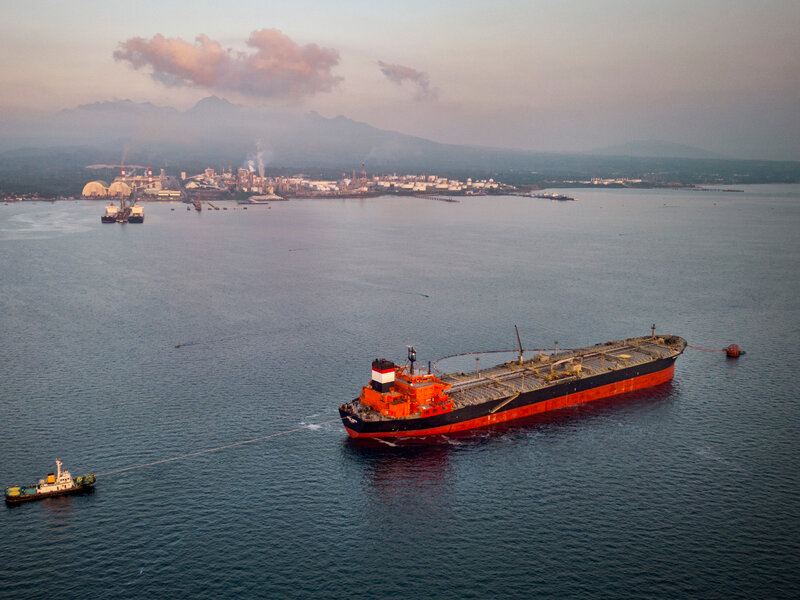
Russian Crude Exports Hit 2026 High, But Prices and Revenue Slump
Russia's seaborne crude exports surged to a record high for 2026 in late June, but the jump in volumes failed to generate a corresponding increase in revenue. A major shift in Middle East geopolitics and the large-scale return of Iranian crude to international markets have not only hammered prices for Russia's key export grades but also squeezed its oil income.
In the four weeks through June 21, Russia's average daily crude exports reached 3.89 million barrels, a new high for the year, according to Bloomberg, citing vessel-tracking data. On a weekly basis, 38 tankers loaded 28.79 million barrels of crude and departed ports, pushing the daily average to 4.11 million barrels — also a 2026 record.
Russia's daily crude exports have averaged 3.52 million barrels so far this year, exceeding the annual averages recorded since the outbreak of the Russia-Ukraine conflict in February 2022. Bloomberg noted that weekly figures can fluctuate due to weather conditions, port maintenance, the intensity of Western sanctions enforcement, and shipping schedules, but the overall growth trend is unmistakable.
The increase in export volumes stems partly from Ukraine's sustained drone strikes on Russian refining infrastructure. Attacks have extended from refineries near Moscow to the Tyumen refinery in the Urals region, roughly 2,000 kilometers from the Ukrainian border, causing localized gasoline shortages in Russia. The damage to refining capacity has effectively forced Russia to export more crude rather than process it into refined products.
Iranian Crude Returns, Squeezing Russian Market Share
Just as Russia ramped up crude exports, the competitive landscape of the global oil market shifted dramatically. After the US and Iran reached a temporary peace agreement, the Strait of Hormuz reopened and the US Navy lifted its blockade of Iranian ports.
According to the Korea Economic Daily, citing Bloomberg vessel-tracking data, at least three US-sanctioned Iranian Very Large Crude Carriers (VLCCs) — the Elva, Burgo, and Bi Gorg — entered the Strait of Hormuz on June 22, carrying roughly 6 million barrels of Iranian crude bound for Singapore, where ship-to-ship transfers would facilitate final delivery to China. Over the weekend, at least 11 more tankers loaded with approximately 20 million barrels of crude departed from Iran's Chabahar port.
As part of the interim peace deal, the US Treasury Department's sanctions waiver on Iranian oil sales will remain in effect through August 21. During this window, vessels previously stranded by the conflict are resuming shipments, accelerating the flow of Iranian crude into the market. Because certain Iranian light crude grades can serve as quality substitutes for Russia's Urals crude, this poses a direct threat to Russia's market share in Asia.
Previously, with Strait of Hormuz transit disrupted and the US granting a sanctions waiver on Russian exports, Russia had successfully expanded sales to major buyers such as India. That waiver, however, expired on June 17. If it is not renewed, Asian refiners may pivot further toward more competitively priced Middle Eastern crude.
Prices and Revenue Shrink in Tandem
The easing of Middle East tensions has significantly depressed international oil prices. Global benchmark crude prices have fallen roughly 16% since early June, while prices for Russia's main export grades have dropped by about 20%.
According to pricing agency Argus Media, in the week through June 21, the average price for Urals crude loaded from Baltic Sea ports fell by roughly $8.10 to $69.98 per barrel. Urals loaded from Black Sea ports dropped $7.90 to $69.37, and the average price for ESPO crude from Pacific ports declined $7.40 to $79.87 per barrel.
The price decline has directly eroded Russia's oil revenue. Data shows that in the four weeks through June 21, the total value of Russia's crude exports fell to $1.72 billion per week, down sharply from $2.02 billion in the prior four-week period. On a single-week basis, export revenue was approximately $1.98 billion, a $70 million decline from the previous week. The price of Russian crude delivered to India fell for a ninth consecutive week, dropping $8.80 to $90.36 per barrel.
On Asian routes, the four-week average volume of Russian crude heading to Asia — including vessels with undisclosed final destinations — rose to 3.73 million barrels per day, up from 3.65 million barrels per day in the prior period and the highest level since 2022. Notably, cargoes without a declared final destination surged to roughly 1.95 million barrels per day. Of that total, about 1.56 million barrels per day originated from Russia's western ports, labeled as heading toward Port Said or the Suez Canal, while roughly 390,000 barrels per day were carried by tankers showing no destination at all. Such non-disclosure of final destinations is common under sanctions; some tankers update their information only after entering the Arabian Sea, while others never reveal their final port before discharging.
Sentiment Diverges from Fundamentals
Despite elevated export volumes from both Russia and Iran, oil prices are being heavily suppressed by market sentiment and policy rhetoric. Dan Dicker, a 25-year veteran of NYMEX energy futures trading, told Bloomberg that President Trump's frequent negotiation-related statements have exerted a persistent influence on market expectations, preventing prices from reflecting actual supply-demand conditions.
"What you're seeing is the president talking the market down, but the real supply-demand situation is starting to show through in ways it didn't during the three months of conflict," Dicker said. Since the US and Israel launched military action against Iran in late February, the disruption of Strait of Hormuz transit had created a daily global supply deficit of roughly 6 million to 8 million barrels.
However, after Pakistan and Qatar issued a joint statement confirming that the US and Iran had agreed on a 60-day peace roadmap, market anxiety rapidly subsided. On June 22, WTI crude traded around $75 per barrel and Brent around $79 — a stark contrast to the escalation period, when WTI surged to $112 in early April and Brent breached $118 in late March.
Dicker cautioned that traders remained wary of building long positions throughout the conflict because Trump repeatedly announced near-deals over weekends, undermining the bullish thesis. "Traders didn't want to pay for oil that should have been well above $110 or $115," he noted. Following the current memorandum of understanding, market participants are broadly unhedged on the long side and have instead built a notable short position around the $75 to $76 level.
Dicker believes current oil prices are significantly disconnected from supply-demand fundamentals. Over the past two years, oil traded in a stable $55 to $75 range with balanced supply and limited volatility — conditions that have now fundamentally changed. He further analyzed that global oil companies are currently drawing on roughly 500 billion barrels of inventories to bridge the gap, but if large volumes of crude cannot return to supply in the near term, the market faces a major shock. Dicker even predicted that once the potential supply problem fully materializes, crude prices could be driven as high as $135 per barrel.
"The market is far too complacent about what the next 60 days look like, especially given the uncertainty around the deal itself and the outlook for Strait of Hormuz transit," Dicker added. "The premium you're holding can be destroyed by a single sentence from the president." Against this backdrop of tightening fundamentals clashing with geopolitical sentiment, the divergence between Russia's crude export volumes and revenues may persist, with its future income highly dependent on the trajectory of sanctions waivers and the evolution of the Middle East situation.